Prostheses after genital surgery

Prostheses can be fitted following genital surgery for masculinisation. Testicular prostheses are an option following either a metoidioplasty or phalloplasty. However, Erectile prostheses are only possible following a phalloplasty. To have either a testicular or erectile prostheses inserted, you will need to undergo another operation. You may also decide that you do not wish to undergo further surgery, or to have the further surgery later. On this page, you can read more about the various non-surgical options and the different functions of the prostheses.

Cover image

No operation (yet)

Perhaps you do not wish to have surgery to have prostheses fitted, do not wish to have prosthesis surgery yet, orare on a waiting list for a prosthesis. Even without surgery, there are options to alleviate feelings of dysphoria; we refer to these as non-medical options. Instead of a penile prosthesis, there are other ways to make penetration possible. You might be able to get the penis stiff enough using a ‘normal’ tight condom. However, there are also special condoms: the exocondom or penis sleeve. These are aids that you can pull over your penis. An exocondom consists of a silicone sheath and a hard plastic tip. This allows you to stiffen the penis, making penetration possible. You can have an exocondom custom made so that it fits well and meets your aesthetic preferences. The price is around 350 euros (in 2026). Suppliers include Vigo Group and Eqwal. A cheaper alternative is the DuroSleev, costing around 20 dollars (in 2026). A penis sleeve is pulled over the penis, making penetration possible. Penis sleeves come in many shapes, materials and sizes. There are also penis sleeves with a ribbed interior, which can make removing the sleeve feel pleasurable. Several suppliers can be found online, and prices vary significantly.
Following a phalloplasty, it is possible to use a lifter (such as the Elator or Stays-Hard device). This is an external aid consisting of two rings and a thin splint. Please note: you need a glans rim to use this device. The price for a fitted lifter is around 300 euros (in 2026), and the product is currently only manufactured in the United States. If you buy a one-size fits-all lifter, it will cost around 100 euros (in 2026).

About testicular prostheses

Testicle prostheses are implants for the scrotum. Testicle prostheses can be inserted into the scrotum following a metoidioplasty or a phalloplasty. People tend to have this operation, to make the appearance and feel of their genitals better align with their identity. The surgery can be carried out at least 6 months after the last genital operation, provided everything has healed properly. In addition, your scrotum must have enough space for a prosthesis, and you must be able to urinate normally. This will be assessed by the doctor. You can find a detailed explanation of testicular prostheses in the animated video from Amsterdam UMC..
To ensure a safe operation and the best possible outcome, it is important that you do not smoke and are at a healthy weight (BMI greater than 18 and less than or equal to 30). Would you like to calculate your BMI yourself? You can do so on the Voedingscentrum website.

Possible complications during or after the operation

Problems (complications) may arise during or after the insertion of the testicular prostheses, even if the operation has been carried out correctly. Possible complications include post-operative bleeding or an infection. The prosthesis can also protrude spontaneously; this is known as erosion. In 5% of cases, one of the testicular prostheses needs to be removed due to a complication. If necessary, the prosthesis can be inserted again later.
Sometimes, after the procedure, it becomes apparent that the prostheses are not sitting correctly in the scrotum, which can cause discomfort. You can have a correction carried out to rectify this.

About penile prostheses

There are various types of penile prostheses that can be implanted in the body following phalloplasty. This means that the prostheses is not visible from the outside. For many trans men and gender-diverse people, a penile prosthesis is the only way they can penetrate with their penis during sex.
However, the success rate of the operation is limited. Three years after implantation, approximately 30 per cent (that is, 3 out of 10) of the prostheses are functioning without complications. This means that around 7 out of 10 people experience problems within three years of implantation. You can discuss your wishes, sexual functioning and expectations regarding a prosthesis with your urologist and sexologist. A clearer explanation of penile prostheses can be found in this animated video produced by Amsterdam UMC..

Conditions for penile prostheses

The penile prosthesis operation can be carried out - at the earliest - one year after your last genital operation, provided everything has healed properly. In addition, you must be able to urinate properly, and the penis must be of a suitable size for the penile prosthesis to work effectively. The urologist will assess your urinary function and the size of your penis. You can have an erectile prosthesis fitted following a urethral lengthening procedure, but it usually takes more than a year after this procedure for you to have fully recovered. When fitting the prostheses, the existing scars are utilised as much as possible.
Before the operation, you will also have a consultation with a sexologist. This may be your current psychologist. During this consultation, you will discuss, amongst other things, your sex life, which surgical technique you prefer and what your (sexual) expectations are. The sexologist will not make any judgements about whether an erectile prosthesis is a viable option for you; this will be assessed together by the urologist and your supporting psychologist, based on your psychosocial situation and physical condition. To ensure a safe operation and the best possible outcome, it is important that you do not smoke and are at a healthy weight (BMI above 18 and below or equal to 30).

Types of penile prostheses

There are several types of penile prostheses from different manufacturers. Some are specifically designed for trans men and gender-diverse people who have undergone phalloplasty (for example, Zephyr Surgical Implants).
There are two types of prosthesis:
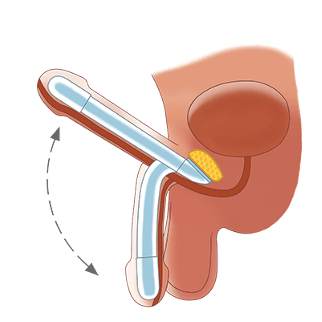
  1. The ‘semi-rigid’ prosthesis. This is a small rod that you can bend into the desired position. You can straighten or bend the penis by hand. If you also wish to have testicular prostheses, these are fitted in a separate operation. This type of penile prosthesis is easy to use and lasts a long time. However, one disadvantage is that the penis is always slightly stiff, which can sometimes make it difficult to conceal, for example in tight trousers or swimming trunks. Additionally, with this kind of prosthesis, there is constant tension on the skin which increases the risk of the prosthesis spontaneously protruding through the skin.
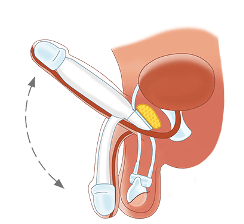
  2. The hydraulic or inflatable penile prosthesis. With this prosthesis, a small balloon filled with fluid is placed in the lower abdomen, with a small pump in the scrotum. Squeezing the scrotum causes the penis to become erect, as the fluid flows from the balloon to the prosthesis. Pressing the top of the pump deflates the prosthesis and the penis returns to a flaccid state. The pump also serves as a filler for the scrotum, meaning that if you wish to have scrotal prosthesis only one needs to be inserted as the pump fulfils the role of the other. This type of penile prosthesis can mimic both a flaccid and an erect state. This also puts less strain on the skin, thereby reducing the risk of the prosthesis protruding through the skin. Inflatable penile prostheses are, however, prone to break more quickly because they are a complex system.
1. De ‘buigbare’ erectieprothese.png

1. 'Flexible' erectile device

2. De hydraulische erectieprothese.png

2. Hydraulic erectile devices

Possible complications during or after the procedure

Problems (complications) may arise during or after the insertion of the prosthesis, even if the operation has been carried out correctly. Complications are common with penile prostheses. Around 70% (7 in 10 people) experience a problem within 3 years. Possible early complications include post-operative bleeding or an infection. In most of these cases, the prosthesis will need to be removed. Once you have fully recovered, the prosthesis can be reinserted. You may also experience pain or discomfort in the genital area or at the site where the prosthesis is attached. Furthermore, the prosthesis may affect your ability to urinate if you have a urethral extension.
The prosthesis may shift position or protrude spontaneously due to pressure on the skin. In such cases, the prosthesis must be removed. However, an attempt may be made to reinsert the prosthesis at a later point in time. It is also possible for the prosthesis to break without any displacement or infection. In this case, the broken prosthesis is removed, and a new one is inserted during the same operation.
The tip of the penis may droop if the prosthesis is too short. This can lead to problems with penetrative sex. With a hydraulic penile prosthesis, complications may also arise in the abdomen, such as bleeding, infection or damage to surrounding organs.
Erectile prostheses frequently fail. Each time you may wish for your protheses to be replaced. Repeated operations for reinsertions of new protheses can increase complication risk. Every repeat operation results in scar tissue and can result in further complications. For example, scar bands (adhesions) can cause the penis to shorten slightly or become curved.

Health insurance

At the time of writing (2026), the fitting of a penile prosthesis is covered by Dutch health insurers. If in doubt, please contact your health insurer.

Aftercare

Advice on aftercare may vary between healthcare providers. However, it is advised to keep the penis elevated for the first two weeks after the operation. You should not swim, take a bath, or go to the sauna until the wounds have fully healed. This usually takes at least two weeks and prevents the stitches from dissolving too early and the wounds from reopening. Short showers are permitted.
A hydraulic penile prosthesis must be activated every day for the first few months. After this, you can reduce this to a few times a week.
After about 2 weeks, you will attend a follow-up appointment at your healthcare facility, and again 2–4 weeks after that. You must not have sex until everything has healed properly (at least 6 weeks). Initially, paracetamol is recommended for pain relief. If the pain worsens or if you experience swelling or redness in the area where the operation took place, please contact your healthcare provider or treating doctor.

Sexual activity

Sexual activity is different for everyone and important to most people. Once your penis has recovered sufficiently, you can have sex with your penile prosthesis. You can’t have sex until you have attended a follow-up appointment at your healthcare facility; there, you can discuss your recovery during the follow-up consultations with the plastic surgeon.
For more information about sexual activity after prostheses, please visit this page.
If you have any questions about your specific treatment or would like to make an appointment with a healthcare professional, please contact your own doctor or healthcare provider.

This text was edited on 3-11-2026


Back
Next Article

Content

Next Step

We recommend that you go through all the information chapters step by step to get a complete picture of the various treatment options and the process involved!We strive to keep this information up to date. Do you have any additions or comments regarding the information above? Please email us at [email protected]

Back to overview

Phalloplasty

Phalloplasty is a surgical procedure in which a penis is created using tissue from elsewhere in your body. The technique used depends on your body and your preferences.

Continue
GenderAid Logo

GenderAid: The Decision Guide for Gender-affirming Genital Surgery

Any questions or feedback?

Please contact us by email:

[email protected]

Department of Plastic, Reconstructive and Hand Surgery

Center of Expertise on Gender Dysphoria

Amsterdam UMC, VUmc location | 4D118

De Boelelaan 1117, 1081HV Amsterdam, Netherlands

Privacy

© 2026 GenderAid. All rights reserved